Aug 21, 2026
Complete Beginner Guide to Radial Tires | Key Differences Between Radial & Bias Tires
1. What Is A Tire? 4 Core Functions Of Vehicle Tires. 2. Two Major Tire Constructions: Bias Tire & Radial Tire. 3. 3 Classifications of Radial Tires (Must-Know For Tire Buyers).
Complete Beginner Guide to Radial Tires | Key Differences Between Radial & Bias Tires
1. What Is A Tire? 4 Core Functions Of Vehicle Tires
A tire is an annular elastic component compounded with rubber and high-strength reinforcing materials, fitted for passenger cars, motorcycles, light trucks, construction machinery, agricultural equipment and all types of vehicles. As the only vehicle part touching the road surface, tires carry 4 essential functions:
- Load Bearing: Support curb weight of vehicles, plus extra weight from passengers and cargo;
- Power Transmission: Deliver driving force, and realize braking & precise steering control;
- Shock Absorption: Cushion bumps and impact from rough roads to improve riding comfort;
- Driving Safety: Generate stable road grip via tread patterns to prevent skidding on dry and wet pavement.
2. Two Major Tire Constructions: Bias Tire & Radial Tire
Two basic tire constructions are available in the market: bias tire and radial tire. Radial tires have become the standard fitment for all passenger cars and light commercial vehicles nowadays.
Basic Features of Bias Tires
The cords inside bias tires cross each other diagonally, with a crown cord angle of around 50°. The carcass bears 80%-90% of driving stress, and carcass plies always come in even numbers. Without steel belt reinforcement, bias tires lack high-speed stability and load capacity. They are only applied to vintage construction equipment and farm machinery at present.
Definition of Radial Tires
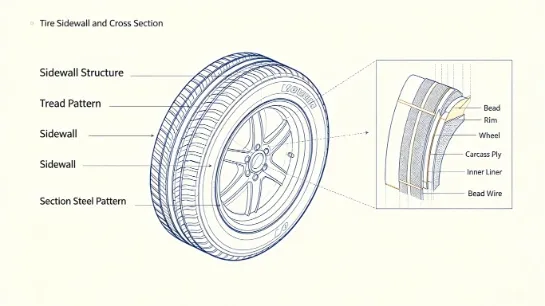
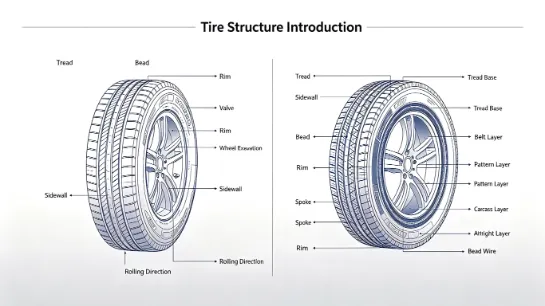
Cords of radial tires run straight from one bead to the opposite bead, forming a 90° angle with the tread centerline, just like meridians on a globe, hence the name “radial tire”. A steel belt layer is added under the tread, bearing 75%-80% of total vehicle load, which firmly maintains tread shape and delivers far better deformation resistance than bias tires.
3. 3 Classifications of Radial Tires (Must-Know For Tire Buyers)
All steel, semi-steel and full-fiber tires only belong to radial tire categories; bias tires have no steel cord structures at all.
- Semi-Steel Radial Tires Polyester/fiber cords are used for carcass, while high-tensile steel wires form the belt layer. This is the standard tire for passenger sedans, urban SUVs and light pickup trucks, also the core product of tire trading companies.
- All-Steel Radial Tires Both carcass and belt layers adopt steel cords with extreme load capacity, designed for heavy-duty trucks and long-distance buses.
- Full-Fiber Radial Tires Fiber materials are used for both carcass and belts, featuring lightweight and low cost. Mainly fitted for low-speed motorcycles and small utility machinery.
4. Core Advantages of Radial Tires Over Bias Tires
- Higher Safety: Steel belts restrict tread deformation at high speeds, delivering stable braking grip and lower blowout risks;
- Longer Service Life: Even force distribution reduces tread wear, extending mileage by over 30%;
- Better Fuel Efficiency: Lower rolling resistance cuts fuel consumption under identical driving conditions;
- Balanced Comfort & Handling: Flexible sidewalls absorb road vibration, while rigid tread prevents body roll during turning and lane changes;
- Superior Puncture Resistance: Steel belts block sharp objects from penetrating the inner carcass for longer off-road durability.
5. Vehicle Types Matching Radial Tires
- PC Passenger Car Tires: 4-door sedans, 2-door sports coupes
- LT Light Truck Tires: Mini pickup trucks, light box delivery vans
- UL Two-Wheeler Tires: Motorcycles, electric scooters
- OR Off-Road Tires: All-terrain vehicles, SUVs
- AG Agricultural Tires: Tractors, farm operation machinery
- ID Industrial Tires: Forklifts, warehouse industrial vehicles